

A friend of mine — decent singer, decent room, decent mic — sent me a vocal take last year that sounded like it was recorded through a wall. Thin, hissy, buried under a layer of noise that no amount of processing was going to fix. He was running a Shure SM7B straight into a budget interface with the gain cranked to about 95%. The interface was doing its best. It just wasn't enough.
So what does a mic preamp actually do? It takes the extremely quiet electrical signal your microphone produces and makes it loud enough to be useful. That's the short answer. The longer answer involves noise floors, circuit topology, and the surprisingly large difference between "making something louder" and "making something louder well."

Waveform amplitude comparison across different masters — the quieter version shows how insufficient gain leaves your signal thin and buried, while proper gain gives you a full, usable waveform. CC BY-SA 4.0, Kosmosi via Wikimedia Commons
Why Your Microphone Can't Do It Alone
Microphones output what engineers call mic level. For a typical dynamic mic, that's somewhere around -56 dBV. Condensers are a bit hotter, usually -36 to -46 dBV. Either way, it's far too quiet for anything downstream — your converter, your compressor, your monitors — to work with.
Line level sits around +4 dBu in professional gear. That's the operating standard. The gap between mic level and line level can be 40, 50, 60 dB or more depending on the mic and the source.
The preamp closes that gap. It applies gain — voltage amplification — to bring your mic signal up to line level. How much gain you need depends entirely on what you're recording.
| Source + Mic Type | Typical Gain Needed |
|---|---|
| Close-miked snare (dynamic) | 15–25 dB |
| Vocalist at 6 inches (condenser) | 30–40 dB |
| Vocalist at 6 inches (SM7B) | 50–60 dB |
| Ribbon mic on acoustic guitar | 55–65 dB |
| Quiet ambient room mic | 60–70 dB |
Here's where it gets tricky. The more gain you apply, the more you amplify everything — including the noise generated by the preamp circuit itself. A preamp with a high noise floor might give you 60 dB of gain on paper, but the last 15 dB come with an audible hiss. A better preamp gets you to the same level with less noise riding along. That's what people mean when they talk about "clean gain."
Your Interface Already Has a Mic Preamp — Is That Enough?
Yes, your audio interface has preamps built in. That gain knob on the front? That's a preamp. And honestly, for a lot of home studio setups, it works fine.
We get asked about this constantly, and our answer is always the same: it depends on what you're recording with and what you're hearing. If you're running a medium-output condenser and your recordings sound clean at 35 dB of gain, you don't need to spend more money. Full stop.
But interface preamps hit a wall. They're built to a price point, and the compromises show up in two places: noise at high gain, and headroom at high output. Try running a ribbon mic or an SM7B through a $150 interface. You'll need 55+ dB of gain, and most budget preamps start falling apart above 45. The noise floor rises, there's a low-frequency hum that compression makes worse, and the transient response gets mushy.

Focusrite Scarlett 2i2, 2i4, and 6i6 — those red gain knobs on the front are preamps. For many home studios, these built-in preamps are all you need. CC BY 2.0, Matt Vanacoro via Wikimedia Commons
The other thing interface preamps don't give you is character. They're designed to be neutral. Which is fine — until you want something that isn't neutral.
Clean Preamp vs Colored Preamp: Two Different Tools
This is the part where preamps stop being boring utility boxes and start being creative tools.
The Clean Side
A clean preamp amplifies your signal without adding much of itself. You hear the mic, the room, the performance. That's it. Solid-state, fully discrete designs with no output transformer tend to fall in this camp.
Clean is what you want when the source is already interesting on its own. Classical guitar. A well-tuned grand piano. Dialogue recording where accuracy matters more than vibe. You're not looking for the preamp to "do" anything — you're looking for it to get out of the way.
The HO2 is built around this idea. Six discrete opamps per channel, 75 dB of gain, and a noise floor low enough that you can run a ribbon mic wide open without hearing the circuit. We designed it to sound like nothing. That was the goal.

Z&H HO2 — six discrete opamps per channel. We designed it to sound like nothing. Push the gain with the pad engaged and it becomes something else entirely.
Thing is, the HO2 has a trick. Engage the pad and push the gain higher — you're driving the discrete opamps harder while keeping the output level in check. The result is more harmonic content, a bit more weight in the low mids. Same preamp, different character depending on how you run it. We've had people tell us they use it clean for overheads and "pushed" for kick and snare on the same session.
The Colored Side
Colored preamps add harmonic content to your signal. That comes from two places: transformers and tubes.
Transformers introduce magnetic saturation as you push level through them. This saturation is frequency-dependent — low frequencies saturate first, which is why transformer-coupled preamps add warmth and body rather than harsh distortion. The classic API 312 and Neve 1073 designs that defined the sound of 70s rock? Both transformer-coupled. That thickness and punch you hear on those records isn't just the console. It's the preamp transformers being driven hard.
Tubes add their own harmonic signature, primarily even-order harmonics that the ear perceives as smooth and warm. A tube preamp at moderate gain sounds gentle. Push it and you get a compressed, saturated character that sits in a mix without much effort.
The transformer-coupled V12 uses a handmade 2520 discrete opamp and a 2503 output transformer — same topology as the classic American preamps from that era. At low gain it's fairly clean. At higher gain the transformer starts contributing, and you get that punchy, forward character that works so well on drums and rock vocals. Not subtle. Not trying to be.

Z&H V12 — transformer-coupled 500-series preamp. At higher gain the 2503 output transformer starts contributing that punchy, forward character.
Which One Should You Pick?
Honestly? Both, if you can swing it. That's not a sales pitch — it's how most working studios operate. Clean preamps for sources that need transparency. Colored preamps for sources that need vibe. You don't eat every meal with the same spice.
If you can only get one, think about what you record most. Vocals in a treated room? Clean first, add color later with plugins if you need it. Rock band tracking? Something with a transformer will get you further faster.
What Preamp Specs Actually Sound Like
Spec sheets are full of numbers that look impressive but mean nothing until you hear what they do. Three specs matter more than the rest, and each one shows up in your recordings in a specific way.
Slew Rate: Why Fast Preamps Sound Clearer
Slew rate measures how quickly a preamp's output voltage can change — usually expressed in volts per microsecond (V/us). Think of it as the preamp's reflexes. A fast preamp can follow rapid signal changes accurately. A slow one can't keep up.
Why does that matter? Music is full of transients — the initial attack of a snare hit, the pick strike on an acoustic guitar, the consonants in a vocal. These transients happen in microseconds. A preamp with a low slew rate literally can't move its output fast enough to reproduce them faithfully. The peaks get rounded off, the attack softens, and the recording loses definition. It still sounds like a snare. It just doesn't feel like one.
The difference is obvious on drums. Record a snare through a slow preamp and a fast one, then compare the waveforms. The fast preamp preserves the sharp initial spike — that crack you hear in the room. The slow one smears it. The attack is duller, the hit feels less immediate, and in a dense mix, the snare starts disappearing behind the guitars instead of cutting through.
We designed the HO2 and HO8 with high slew rate discrete opamps specifically for this reason. When you're tracking a full drum kit through eight channels, you need every transient intact — kick attack, snare crack, hi-hat sizzle, all of it. A preamp that rounds off those peaks is costing you detail before you even hit the converter.
Acoustic instruments benefit too. A fingerpicked guitar has a complex attack envelope — the nail hitting the string, the body resonating, the overtones blooming. A fast preamp captures all three phases distinctly. A slower one blurs them together into something that sounds... fine. But less alive.

Clean snare transient — sharp attack spike fully preserved. This is what a fast preamp gives you. Public Domain, Kuuenbu via Wikimedia Commons

Same snare hit with distorted transient — the attack is rounded and smeared. In a dense mix, this snare disappears behind the guitars. Public Domain, Kuuenbu via Wikimedia Commons
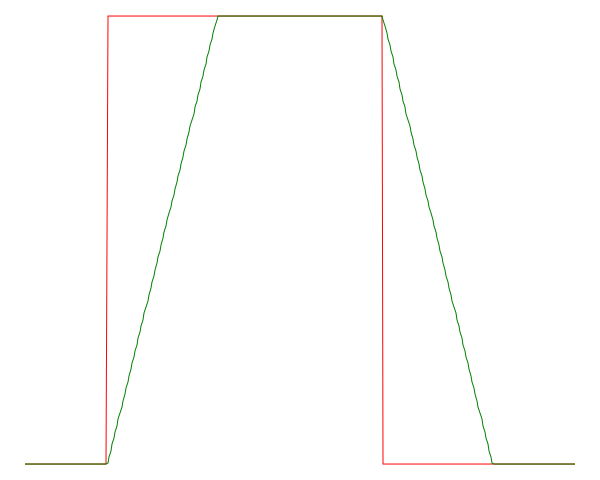
Slew rate visualized — red is the ideal output, green is what happens when the amplifier can't keep up. The steeper the rise, the faster the preamp's reflexes. CC BY-SA 3.0, Yves-Laurent Allaert via Wikimedia Commons
Noise Floor: The Silence Between the Notes
A preamp's noise floor is the amount of self-noise the circuit generates with no signal present. It's measured in dBu or expressed as Equivalent Input Noise (EIN). Lower is better. Simple.
But here's what a low noise floor actually gives you in practice: dynamic range. The quiet stuff stays quiet. The space between notes is actually silent. A singer's breath before a phrase, the room tone between drum hits, the decay of a reverb tail — these details exist in the quiet parts of the signal. If your preamp's noise floor sits at -115 dBu, you hear them clearly. If it sits at -100 dBu, they're buried under a constant hiss.
This gets worse with compression. A compressor brings up quiet passages — including whatever noise your preamp added. Run a vocal through 6 dB of gain reduction and suddenly that "barely noticeable" preamp hiss is very noticeable. A cleaner preamp means the compressor has less garbage to bring up.
At 60 dB of gain — what you'd use for a ribbon mic or a quiet source — the difference between a good preamp and a mediocre one is night and day. Not subtle. Not "audiophile placebo." Actually audible hiss versus silence.
Headroom: How Loud Before It Breaks
Maximum output level tells you how loud the preamp can get before clipping. Most professional preamps max out between +24 and +30 dBu. The HO2 pushes +28 dBu.
In real terms, headroom means you don't have to babysit your gain. A singer who whispers one line and belts the next? With enough headroom, both moments stay clean. A drummer who's playing rimshots one bar and smashing the snare the next? Same deal. The preamp absorbs the dynamics without choking.
Low headroom preamps force you to set gain conservatively, leaving quiet passages too low. Or you ride the sweet spot and pray nobody hits anything too hard. Neither is fun during a session that's going well.
Putting It Together
These three specs work together. A fast preamp with a low noise floor and high headroom gives you recordings that sound open, detailed, and dynamic — you hear the full picture of what happened in the room. A slow, noisy preamp with limited headroom gives you recordings that sound flat, hissy, and compressed before you've even touched a plugin. The spec sheet can't tell you how a preamp "sounds" in a musical sense. But it can tell you how much of your performance the preamp will actually capture.
| Spec | What It Measures | What You Actually Hear |
|---|---|---|
| Slew Rate (V/us) | How fast the output voltage can change | Higher = sharper transients, clearer attack, better separation in dense mixes |
| EIN / Noise Floor (dBu) | Self-noise with no signal present | Lower = cleaner recordings at high gain, less hiss after compression |
| Max Output Level (dBu) | Loudest clean signal before clipping | Higher = more dynamic range, handles loud transients without distortion |
| THD (%) | Harmonic distortion at rated output | Lower = more transparent. Higher (in transformer designs) = more "color" |
| Frequency Response (Hz) | Range of frequencies reproduced accurately | Wider/flatter = more natural, no missing low-end weight or air |
When Does a Standalone Preamp Actually Make Sense?
We're not going to tell you everyone needs one. They don't. Here's when it starts mattering:
You probably need one if: your mic needs more than 45 dB of clean gain (dynamics, ribbons), you're hearing noise or hiss that wasn't in the room, you want harmonic color that your interface can't provide, you're tracking through outboard gear that expects proper line level, or you're recording drums and need 8+ channels of quality gain — the HO8 eight-channel preamp exists for exactly this reason.
You probably don't need one if: your condenser mic sounds fine through your interface at moderate gain, you haven't treated your room yet (fix that first — seriously), you're mostly doing podcast work where neutral is fine, or you simply haven't hit the ceiling of your current setup.
Room treatment before gear. Always. A $2000 preamp in an untreated room just gives you a really clear recording of bad reflections.

Room treatment comes before gear. A great preamp in an untreated room just gives you a really clear recording of bad reflections.
Quick Reference: Mic Preamp Types Compared
| Type | Sound Character | Best For | Gain Range | Watch Out For |
|---|---|---|---|---|
| Solid-State (Clean) | Transparent, detailed, accurate | Classical, acoustic, dialogue, overheads | Up to 75 dB | Can sound clinical if your source is dull |
| Transformer-Coupled | Warm, punchy, harmonically rich | Rock vocals, drums, electric guitar | Up to 69 dB | Saturation increases with gain — use it intentionally |
| Tube | Smooth, round, even-order harmonics | Lead vocals, bass DI, gentle warming | 40–65 dB | Tubes age and drift — replace periodically |
| Interface Built-In | Neutral, varies widely by model | General home studio tracking | 40–60 dB | Noise floor rises sharply above 45 dB on budget units |
The Takeaway
A mic preamp makes your microphone signal loud enough to use. Every recording setup has one — the question is whether the one built into your interface is doing the job well enough, or whether a standalone unit would give you cleaner gain, more headroom, or a sound character you can't get otherwise.
For most beginners, the honest answer is: your interface is fine for now. Use it until you hit its limits. When you do — when you hear the noise, when you want the color, when you're tracking eight mics on a drum kit and need every channel to be clean — that's when a standalone preamp stops being a luxury and starts being a tool you actually need.
Frequently Asked Questions
How much preamp gain do I need for an SM7B?
Typically 55–60 dB. The SM7B has notoriously low output. Most budget interface preamps top out around 55 dB with acceptable noise, which is cutting it close. A standalone preamp with 65–75 dB of clean gain gives you comfortable headroom. Some people use inline boosters like a Cloudlifter, but a better preamp solves the root problem.
Do I need a separate preamp if I have a good audio interface?
Maybe not. Higher-end interfaces from Universal Audio, RME, or Apogee have genuinely good preamps. The gap between those and a $500 standalone unit is small for most applications. Where standalone preamps pull ahead is when you need very high gain, specific tonal color, or multichannel recording with matched channels.
What's the difference between a clean preamp and a colored preamp?
A clean preamp adds gain without changing the tonal character. What goes in comes out louder but otherwise the same. A colored preamp adds harmonic content — warmth from transformers, smoothness from tubes — that changes how the recording sounds and sits in a mix. Neither is better. They're different tools for different jobs.
Can a mic preamp fix a bad recording?
No. A preamp amplifies whatever's in front of the mic, including room reflections, background noise, and bad technique. Acoustic treatment and mic placement come first. A preamp improves a recording that's already fundamentally decent.
Is a tube preamp better than solid-state?
"Better" isn't the right word. Tubes add warmth and compression in a way that solid-state circuits don't replicate exactly. But tubes age, drift, and need replacing. Solid-state is more consistent day to day. For vocals and bass, lots of engineers prefer tubes. For drums and acoustic instruments, solid-state often wins. Personal taste.
How much should I spend on a mic preamp?
$300–700 gets you into seriously capable standalone preamps that outperform most interface preamps. Above $1000 you're paying for specific sonic character, precision matching between channels, or specialty features like variable impedance. Don't spend $2000 on a preamp if your room sounds bad — that money goes further on treatment.
Do I need phantom power from my preamp?
Only if you're using condenser microphones. Condensers need +48V phantom power to operate. Dynamic and ribbon mics don't. Most modern standalone preamps include phantom power — just make sure it's switchable per channel so you don't accidentally send 48V into a ribbon mic. That can cause damage.
Z&H Designs builds microphone preamps for studios that care about what goes in before anything comes out — from the clean, transparent HO2 and HO8 to the transformer-driven V12. All handmade, all discrete circuitry, all linear power supplies. See the full range at zhdesigns.audio.

Z&H Designs preamp lineup — all handmade, all discrete circuitry, all linear power supplies.
Sources
- Sound On Sound, "The Mic Preamp: What It Does & Why It Matters" — soundonsound.com
- Shure, "What Is a Microphone Preamplifier?" — shure.com
- Jensen Transformers, "Audio Transformers" (Technical Paper) — jensen-transformers.com (PDF)
- RME, "Matching Analog and Digital Audio Signal Levels" — rme-audio.de
- Gearspace Discussion, "Budget Preamps vs Interface Preamps — Real Difference?" — gearspace.com
- Universal Audio, "Gain Staging Explained" — uaudio.com
- Sound On Sound, "Transformer Design in Audio Equipment" — soundonsound.com
Image Copyright Notice: All images used in this article are utilized under Fair Use provisions for educational and technical review purposes. Original copyrights remain with their respective owners. If copyright infringement occurs, please contact us for removal.


