

Walk into a serious studio and you see four compressors on the wall, because four different things happen inside those boxes. One snaps onto a snare like a trap. One hugs a vocal so smoothly you forget it's working. One sits down on a mix and gives it weight. One does exactly what you tell it. No more, no less.
VCA vs Opto vs FET vs Vari-Mu. Four ways to reduce gain. Four sound signatures. Picking the right compressor type for your mix has more to do with what you record than with brand names or vintage credentials. This is a guide to choosing between them by ear, written by people who manufacture one of each.

A real working studio rack. LA-2A optical, dbx 160 VCAs, Distressors, Manley Variable Mu, Tube-Tech, Shadow Hills, all in one column. Optical, FET, VCA, and tube topologies side by side
The Four Gain Reduction Elements at a Glance
If you only have two minutes, this is the article.
| Element | Speed | Character | Famous classic | Best on |
|---|---|---|---|---|
| FET | Very fast (microseconds) | Aggressive, exciting, gets nasty when pushed | UREI 1176 | Vocals with attitude, drums, bass DI, parallel buses |
| Optical | Slow attack, two-stage release | Smooth, program-dependent, breathes | Teletronix LA-2A | Intimate vocals, bass sustain, acoustic instruments |
| Vari-Mu | Slow, patient | Three-dimensional weight, glues a mix | Fairchild 670 | Mix bus, mastering, vocal smoothing |
| VCA | Fast and clean | Precise, transparent, disappears or attacks | dbx 160, SSL G Bus | Mix bus, drums under control, anywhere flexibility matters |
Each topology has a physical reason for sounding the way it does. The FET is fast because semiconductors switch in nanoseconds. The optical cell is slow because it's a piece of cadmium sulphide crystal that takes its time. The tube weighs heavy because it's already coloring the signal before it ever compresses. The VCA is precise because it was built to be linear in a way the others can't be.
That physical reason is what makes the topology choice durable. As Sound On Sound's compressor topology overview puts it, the part inside the box is the sound. Plugins emulate the behavior. The underlying character comes from the physical element. Choose by the part.
FET Compressors: The Fast, Aggressive One
An FET (field-effect transistor) sits in the signal path acting as a voltage-controlled resistor. The sidechain's control voltage shrinks the FET's effective resistance, dropping the level. Microseconds. That's why FET compressors snap onto transients in a way nothing else does.
The classic is the UREI 1176. No threshold knob. You drive the input harder to get more compression. Output for makeup. The FET is so fast and so unforgiving that the only way to make it musical is to let the input level decide how hard it hits. This is one of the reasons consistent gain staging matters with FET compression. Input level is the threshold.

UREI 1176 Rev.A. The classic FET compressor. No threshold knob, no apologies, 20μs attack. Photo: John Tuggle
A vocal through a hard-driven FET starts arriving on time. Phrases that drifted now lock to the grid. Push further and you get urgency. Push more and it gets gritty. That's why drum rooms have a 1176-style FET on the bus and rock vocals get printed through one.
Snare and kick room mics that need attitude, drum bus parallel compression, lead vocals on anything denser than a ballad, bass DI when you want the note to stab forward. We almost never reach for FET on a piano, a delicate vocal, or strings. Wrong job.
Drive the input for 3 to 6 dB of GR for smooth use. Push for 10+ dB if you want a statement. Output for makeup. On stereo material, M/S lets you slam the Mid separately from the Sides for density at the center without smearing width.

The Z&H 1178 Stereo Peak Limiter. FET-based, with NPD5566/2N5566 dual FETs on a single silicon substrate, variable sidechain HPF, wet/dry mix knob, and stereo / dual-mono / M-S switching.
Our FET-based 1178 Stereo Peak Limiter keeps this lineage. Same NPD5566/2N5566 FET pair on a single silicon substrate. We added what 1967 didn't have: independent attack and release per channel, a variable sidechain HPF, a built-in wet/dry mix, and stereo / dual-mono / M-S switching.
There's also a Neve-style output transformer that adds an oily, lubricated low end you don't get from a stock 1176. Engage the classic All-Buttons-In mode, or stack any combination of ratio buttons for a palette of different attitudes. Push it hard and the 1178 erupts into something explosive and properly alive, the kind of sound you only get when a FET is driven past polite. Use the Mix knob to find the sweet spot. It all comes together easily.
Optical Compressors: The Smooth, Program-Dependent One
The classic is the Teletronix LA-2A. Companions are the UREI LA-3A and LA-4. All built around one idea. Let the crystal decide.

Inside the LA-2A. Hand-wired point-to-point construction, custom transformers, vacuum tubes, and the T4B optical attenuator at the heart of every unit. Still built this way today.
The compressor doesn't seem to realize it's compressing. A vocal that ranged across 10 dB sits at a consistent level without anything obviously happening. Compression follows the performance. Loud phrases get pulled down smoothly. Quiet phrases barely get touched. The release adapts to the sustained energy in the source. Bass through an optical gets sustain that doesn't feel processed. It feels like the bass was always that present.
Intimate vocals where you want level control without character. Acoustic guitar where dynamics need reining in without choking the attack. Bass when you want notes to hold their weight. Anywhere compression should be heard as the absence of dynamics rather than the presence of compression. We avoid opto on snare or kick because the slow attack lets the transient through entirely, which usually isn't the drum compression goal.
Hit the input at 0 VU. Set peak reduction to target 3 to 6 dB on louder phrases. Leave it alone. Fewer knobs means more trust in the physics.

The VTL5C2 vactrol optocoupler. LED on one side, CdS photocell on the other, sealed in one package. The heart of the Hopto Stereo Optical Compressor.

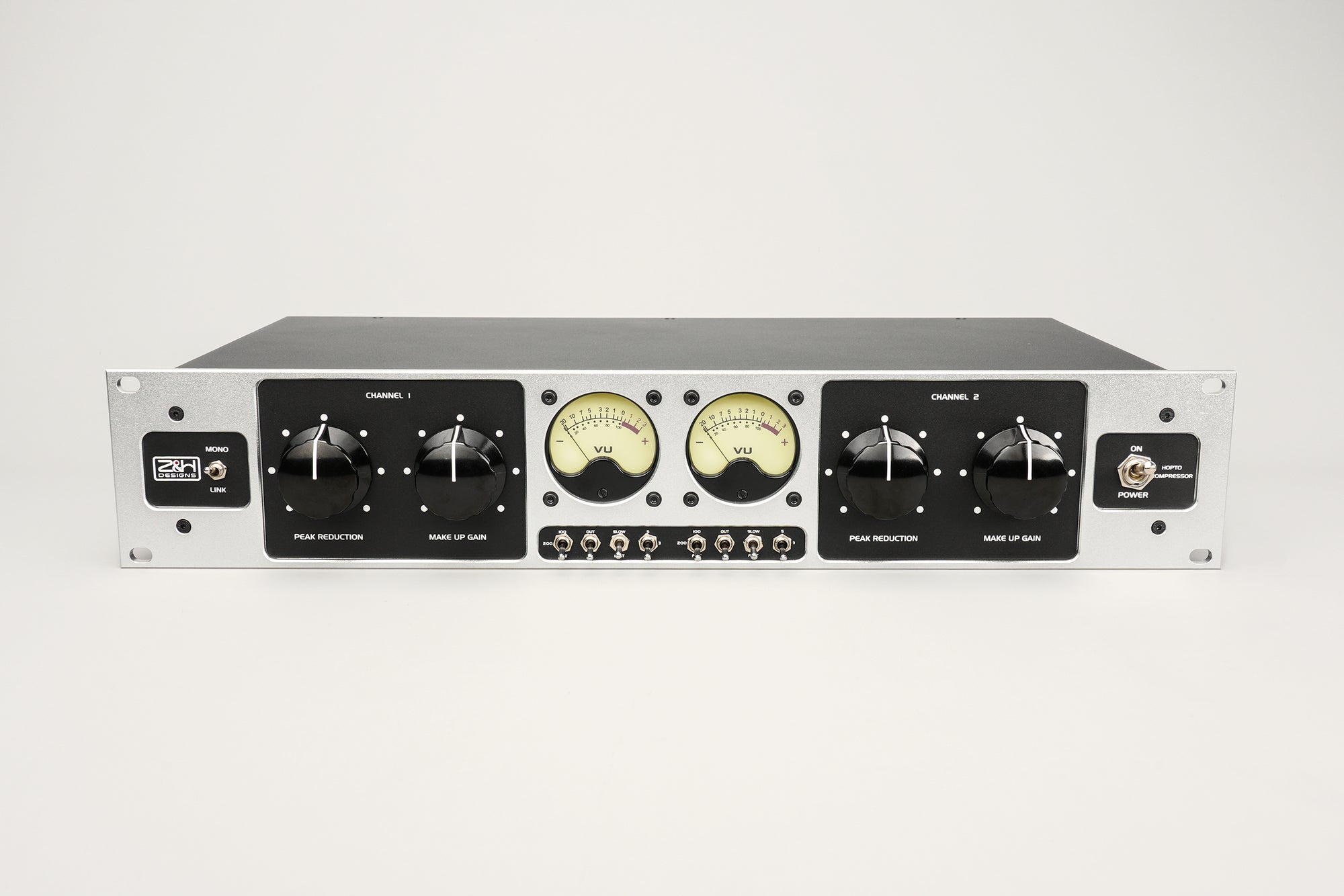
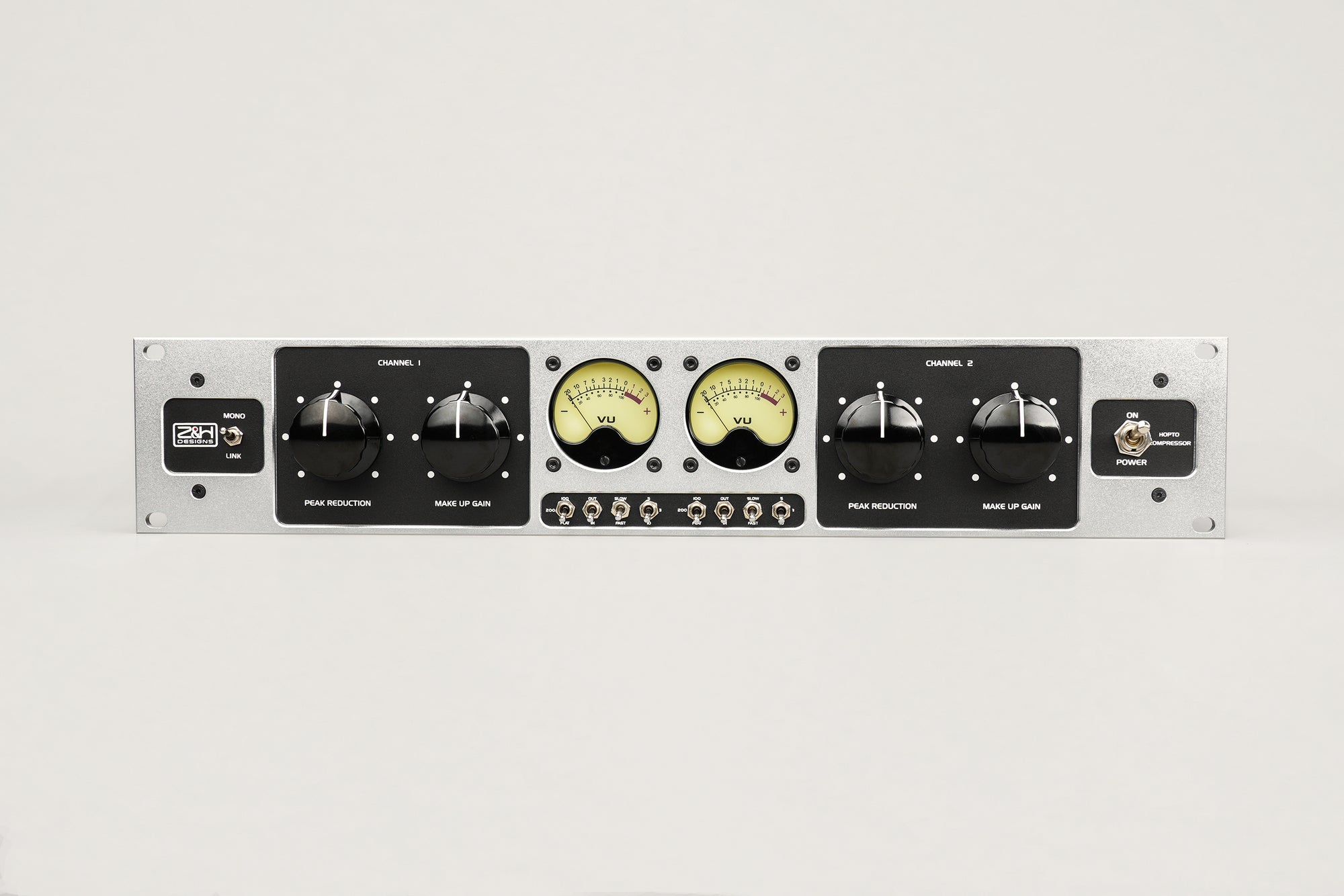
The Z&H Hopto Stereo Optical Compressor. VTL5C2 photocell, fully transistorised all-discrete signal path, LA-2A/3A-style optical compression with stereo and dual-mono operation.
Our VTL5C2-based Hopto optical compressor uses the classic LA-2A/3A topology, fully transistorised and all-discrete. The VTL5C2 has moderate memory effect, not as dramatic as the T4B in vintage LA-2As, but the program-dependent character is unmistakable.
We get orchestral sessions in the studio a lot, and the Hopto on brass is unbelievably silky. Vintage and hi-fi at the same time. ith the classic 990 Opamp paired with Jensen-style transformers. Warm, natural colour, with very little audible compression artifact, so you can pull 10 dB of GR and barely feel it working. Safe to push, and the unit we reach for first during tracking. Switch to fast attack later in the workflow and it handles modern material too. Pound for pound, the best-value stereo optical compressor we know of.
Vari-Mu Compressors: The Three-Dimensional One
Vari-mu compressors work differently from the other three. In FET, optical, or VCA designs, a separate gain element gets controlled by the sidechain. In a vari-mu, the tube itself is the gain element. Control voltage changes the tube's bias, which changes its own gain. So a vari-mu colors the signal before compression even engages, because you're routing through a tube stage that is also a compressor.

The Fairchild 670. Twenty tubes per stereo unit. The most-imitated vari-mu compressor in the world, still on the master bus of plenty of finished records
The classic is the Fairchild 670. The price of a real one buys you a small house. Engineers who've used one keep reaching for the word three-dimensional. The mix gets depth, vocals get weight without thickness, the whole arrangement feels intentional even at 1 dB of GR.
The catch: vari-mu is the most level-sensitive of the four. The window is narrow. 0 to +2 VU input, 1 to 3 dB of GR. Push past that and the magic dies. Mix bus and mastering territory, not corrective work. Good gain staging is non-negotiable.
Our Model 670 is a faithful recreation of that holy grail, built on the original circuit with 11 handmade transformers modeled after the vintage originals. The standard T-Bar MOD configuration uses 16 6BA6 tubes for stability; optional 6386 and 8-tube versions chase the exact vintage spec. Extended time constants, True Bypass, sidechain filter, Gain Trim for stereo matching, and a modern LDO linear supply with auto-voltage detection.
VCA Compressors: The Precise, Versatile One
The VCA (voltage-controlled amplifier) is the youngest of the four topologies. Blackmer's decilinear gain cell finally gave designers an element precise enough to work with simple feedforward sidechains, so you could tell the compressor "reduce gain by 6 dB" and it would actually do it. Classics are the dbx 160 and the SSL G Bus compressor. Modern descendants use the THAT 2181, the IC version of the Blackmer cell.

SSL XLogic 5.1 Multichannel Bus Compressor. The VCA bus compressor that defined an era of mixing
A good VCA does exactly what you tell it. Threshold, ratio, attack, release. Set the parameters and the compressor follows. The "SSL glue" on a mix bus is real, mostly a function of VCA precision combined with the time constants and auto-release of the G-series circuit. The character is whatever you ask for.
Mix bus, almost universally. Drum bus when you want control rather than excitement. Bass when you want the level to sit. We don't reach for VCA when we want the compressor itself to be the sound. We reach for it when we want the sound we already have, just held in place.

The Z&H VCA Compressor. THAT 2181 gain cell, switchable Glue (feedback) and Punch (feedforward) topology, Boom and Spark harmonic controls, Mix knob for parallel compression.
Our THAT 2181-based Z&H VCA Compressor adds a few things to the standard VCA template. TThe Glue/FWD switch is a real sidechain topology change: Glue is feedback, which gives a softer and more adhesive response. FWD is feedforward, the strict SSL G Bus-style topology for classic VCA bus-compressor glue. Boom and Spark add harmonic enhancement at 120 Hz and 10 kHz. Plus a switchable transformer colour stage and a wet/dry mix for parallel compression.
We use it on the drum bus a lot. 4:1 ratio, attack on position 3, release at its fastest setting, targeting 2 to 3 dB of GR on the loudest hits. Engage the transformer colour stage and dial in a small amount of Boom (the 120 Hz harmonic generator) for extra kick weight and a fuller snare body. Spark works the same way at 10 kHz, adding even-harmonic top end that lets cymbals sit forward without harshness. FWD mode (feedforward sidechain) tightens transient response for modern productions and is the strict SSL G Bus-style topology; Glue mode (feedback sidechain) softens it for vintage cohesion. None of these moves is large in isolation, but the transformer stage plus harmonic generators are additive across a full kit.
Choosing Your First Hardware Compressor
If you don't own any hardware compressor yet, the way we usually walk through it depends on what you record most. For vocal-led work like folk, pop, or jazz, we'd start with the Hopto, our rack-mount optical that's forgiving enough to patch in during tracking and forget for half the session. If your sessions lean heavier on drums and rock vocals, the 1178 makes more sense, with All-Buttons mode, the Mix knob, and the M/S option covering a lot of ground in one box.
For engineers who mix more than they track, the VCA Compressor ends up being the daily driver, clean enough to leave on the mix bus from rough to final. The Model 670 is our master bus piece, built specifically for mastering work. We wouldn't suggest it as a first purchase unless your day-to-day is at the end of the chain.
When You Have More Than One: Building a Compressor Rack
A working studio usually ends up with one of each topology. Not for completeness. Because over time you start reaching for specific ones for specific jobs.
Here's a recent day. Pop track came in for mixing. Lead vocal through the Hopto for 3 to 4 dB of program-dependent leveling, then through the 1178 for character and a final 2 dB of grab on the loudest words. Snare through the 1178 in dual-mono, slammed with the wet/dry at about 60% wet for parallel excitement. Drum bus had the VCA Compressor doing 2 dB of glue in Glue mode (feedback), variable sidechain HPF around 80 Hz so the kick didn't drive everything. Mix bus had the VCA Compressor on another channel, and the Model 670 bypassed because the song wanted glue more than weight that day.

A dedicated compressor rack at Supernatural. Different topologies, different jobs, one column. CC BY 2.0 via Wikimedia Commons
Four compressors, four jobs, one mix. None replaceable by another without changing the result. That's the case for owning more than one.
You can also chain them. A vocal chain we use a lot. Opto for level control (Hopto), then FET for character (1178). The opto handles the dynamics. The FET adds the urgency. Either alone is fine. Both together is finished.
Quick Reference: Topology Cheat Sheet
| Need | Reach for |
|---|---|
| Vocal sounds uneven | Optical |
| Vocal needs to come forward | FET |
| Snare needs attitude | FET |
| Drum bus needs control | VCA |
| Drum bus needs energy | FET (parallel) |
| Bass needs sustain | Optical |
| Mix bus needs glue | VCA |
| Mix bus needs weight | Vari-Mu |
| Mastering | Vari-Mu (primary) or VCA (precise) |
| Recall and predictability matter | VCA |
| Tracking through to tape character | FET or Vari-Mu |
| Ducking from a key input | VCA (others usually have no external key) |
The Takeaway
The four compressor topologies aren't "good vs bad" or "vintage vs modern." Four different physical solutions to the same problem, each with a sound character baked into the hardware. FET is fast and aggressive. Optical is smooth and program-dependent. Vari-Mu is patient and three-dimensional. VCA is precise and disappears.
The most useful question isn't "which compressor is best." It's "what does this source need to feel like." Answer that and the topology choice is usually obvious. Live with one of each long enough and you stop thinking about compressors as a single tool. You start thinking about them as a small family of instruments, each for a different job.
Frequently Asked Questions
What is the difference between VCA and FET compressors?
VCA compressors use a voltage-controlled amplifier chip (like the THAT 2181) that's precise and clean. Parameters get followed exactly. FET compressors use a field-effect transistor as a voltage-controlled resistor, also fast but less linear. VCAs tend to sound transparent. FETs tend to sound exciting. Even at the same GR amount. VCAs for mix bus work, FETs for character compression on individual tracks.
Which compressor type is best for vocals?
Depends on the vocal. Intimate, dynamic vocals (folk, jazz, ballads) want optical. The program-dependent response handles natural dynamics without imposing character. Forward, energetic vocals (rock, pop with attitude) want FET. The aggressive front-edge handling adds urgency. If you have to pick one for wide-range vocal work, opto is safer.
Are tube compressors the same as vari-mu compressors?
Most of the time, yes. Vari-mu specifically refers to a compressor where the tube itself is the gain element. There are also tube compressors that use tubes only for output amplification while a separate element (opto, FET) does the gain reduction. Those are tube compressors but not vari-mu strictly speaking. When someone says "tube compressor" without qualification, they usually mean a vari-mu like the Fairchild 670 or Manley Variable Mu.
What does optical compression sound like?
The most accurate description: the compressor doesn't seem to realize it's compressing. Levels even out. Dynamics smooth. Source character stays intact. The two-stage release (fast initial recovery, then a slow tail) creates a sense of breathing that suits sustained material like vocals and bass.
Should my first hardware compressor be a 1176 or an LA-2A?
For most home and small commercial studios doing vocal-forward work, an LA-2A style optical is the better first purchase. More forgiving. More flattering on common sources. Teaches good compression habits. The 1176-style FET is the better second compressor, once you've learned what compression should sound like on neutral material and now want character on aggressive sources.
Do plugins replicate these compressor topologies accurately?
The better ones get close on audible behavior. What they miss is the truly nonlinear part of each topology. Photocell memory in optical units. FET self-correcting overshoot. Tube saturation that happens before compression engages. The specific harmonic signature of a Blackmer cell driven hard. Hardware still has an edge here, though the gap shrinks every year.
Why do mastering engineers prefer vari-mu compressors?
Same reason they reach for tube EQs and analog summing. The harmonic content tubes add at very small amounts of processing gives mixes a three-dimensional weight other topologies don't produce. Mastering is mostly small moves that affect the whole. Vari-mu compressors are uniquely good at small moves that change the perceived density of a mix.
Z&H Designs builds one compressor in each of the four topologies covered here. The FET-based 1178 Stereo Peak Limiter, the VTL5C2-based Hopto Stereo Optical Compressor, the Model 670 Vari-Mu Compressor, and the Z&H VCA Compressor. All hand-built with discrete circuitry, linear power supplies, and the kind of attention you can only give when you make a small number of each. See the full line at zhdesigns.audio.
Sources
Sound On Sound, "Compressor Topology" -- soundonsound.com
iZotope, "4 Types of Analog Compression" -- izotope.com
Wikipedia, "Blackmer Gain Cell" -- en.wikipedia.org
THAT Corporation, "THAT 2181 Series Datasheet" -- thatcorp.com (PDF)
VTL5C2 Optocoupler Datasheet -- Farnell (PDF)
Giannoulis, Massberg & Reiss, "Digital Dynamic Range Compressor Design" (JAES Vol. 60, No. 6, 2012) -- eecs.qmul.ac.uk (PDF)
MixAnalog, "Compressor Topology Explained" -- blog.mixanalog.com
SonicScoop, "Choosing the Right Compressor: VCA, Opto, Vari-Mu or FET?" -- sonicscoop.com
Image Copyright Notice: All images used in this article are utilized under Fair Use provisions for educational and technical review purposes. Original copyrights remain with their respective owners. If copyright infringement occurs, please contact us for removal.




.jpg)